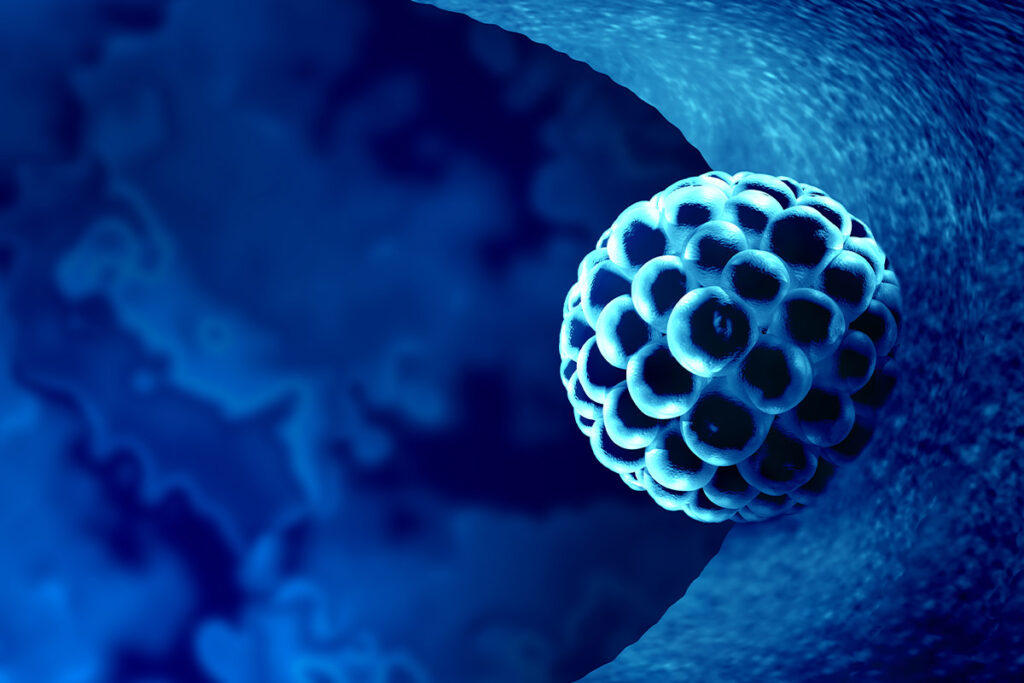
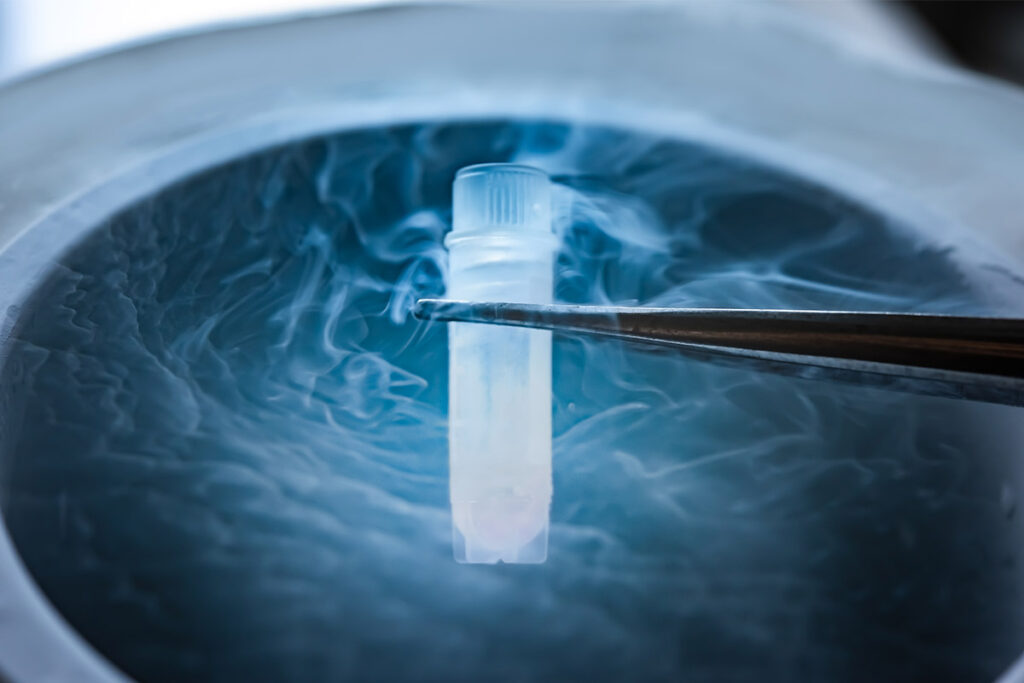
Frozen embryo transfer (FET) is widely considered as part of the IVF treatment and, for many patients starting the assisted conception journey, can provide greater flexibility in how and when the embryo transfer takes place without compromising at all the chances of successful life birth. Many studies in the literature have, in fact, looked at the cumulative live birth rate when considering the transfer of fresh and frozen embryos created in the same cycle of treatment.
Meticulous laboratory protocols and established skill set of the laboratory team are central to the success of FET cycles.
During IVF, good quality embryos that are suitable for cryopreservation can be carefully preserved using a rapid freezing technique known as ‘vitrification’. Embryos can then be stored until the time is right for transfer into the uterus, prior to which it requires the embryo to be thawed, warmed and closely monitored for signs of survival.
Of note, more than 95% of embryos frozen at the stage of blastocyst (day 5 or 6 of development) survive and are suitable for transfer.
So, why might a frozen embryo transfer be recommended?
Giving your body time after IVF stimulation
An IVF cycle involves stimulating the ovaries to encourage several follicles containing eggs to develop, followed by egg harvesting. Rather than transferring an embryo just a few days later, freezing the embryos allows time between these two stages of treatment, thus supporting the woman’s body to recover and restore the physiological environment suitable for embryo implantation.
It has been speculated that for some patients, deferring the embryo transfer for a month or two can be beneficial as it allows the effects of ovarian stimulation to settle.
More flexibility around your treatment
One of the practical advantages of the FET is that the embryo transfer does not have to take place immediately following egg harvesting.
This can offer greater flexibility when planning treatment and means that the timing of the transfer can be considered separately from the stimulation and egg collection stages of IVF.
Helping to manage the risk of OHSS
Some patients have a particularly high response to the medications used to stimulate the ovaries and may be at increased risk of ovarian hyperstimulation syndrome (OHSS).
In these circumstances, the clinical team may recommend freezing all suitable embryos and postponing embryo transfer. This can help reduce the risk of OHSS becoming more severe if pregnancy occurs immediately after stimulation.
Allowing time for embryo testing
If pre-implantation genetic testing (PGT) forms part of the assisted conception treatment, embryos can be frozen after a small number of embryonic cells have been biopsied and sent for genetic testing.
The embryos can remain safely cryo-stored while the results are awaited, after which a genetically competent embryo (i.e., euploid) can be selected for transfer.
The opportunity for future treatment
In the instance that several good quality embryos are created from one IVF cycle, after choosing the one for transfer the remaining embryos can be frozen for possible use in the future.
This approach affords additional opportunities to try for pregnancy if the first transfer is unsuccessful. Alternatively, frozen embryos provide the opportunity of returning for treatment later if planning more pregnancies.
Using an embryo that has already been created means that another cycle of ovarian stimulation and egg collection is not necessary.
Making single embryo transfer possible
For many patients, transferring one embryo at a time is the safest approach because it reduces the likelihood of a multiple pregnancy and the additional risks this can bring for both mother and babies.
Supernumerary suitable embryos do not have to be lost simply because they are not transferred at the same time – instead they can be frozen and stored for potential future treatment.
How well do embryos survive freezing?
Embryo freezing has advanced considerably. Modern fertility laboratories use vitrification of embryos developed to the stage of blastocyst. Vitrification is a safe and established laboratory techniques which entails freezing embryos extremely rapidly and has resulted in very high embryo survival rates and live birth rates. There is no doubt that vitrification has made frozen embryo transfer an established part of modern IVF treatment.
Is frozen embryo transfer right for everyone?
Although the FET offers many advantages, there is no single approach to embryo transfer that is right for every patient.
For some, a fresh embryo transfer may be recommended; for others, there may be clinical or practical reasons why freezing embryos and planning a transfer for a later cycle is preferable.
The fertility consultant will normally consider the patient’s individual circumstances, including response to ovarian stimulation, medical history, development of embryos, requirement for additional investigations or specific medical interventions.
At NOW-fertility, we believe fertility treatment should be patient-centred. Understanding the different options available – and why a particular approach may be recommended – can help patients feel more informed and confident about the decisions to be made throughout the fertility journey.
Professor Luciano Nardo, Founder and President of NOW-fertility, as well as a Dubai and London based consultant in reproductive medicine and infertility with more than 25 years’ experience, says “Every patient’s fertility journey is unique, and tailoring the embryo transfer to specific conditions may give the best opportunity to achieve a live birth. Transferring a healthy, good quality embryo in a finely prepared endometrial environment is a very important step toward success of the IVF cycle.”